
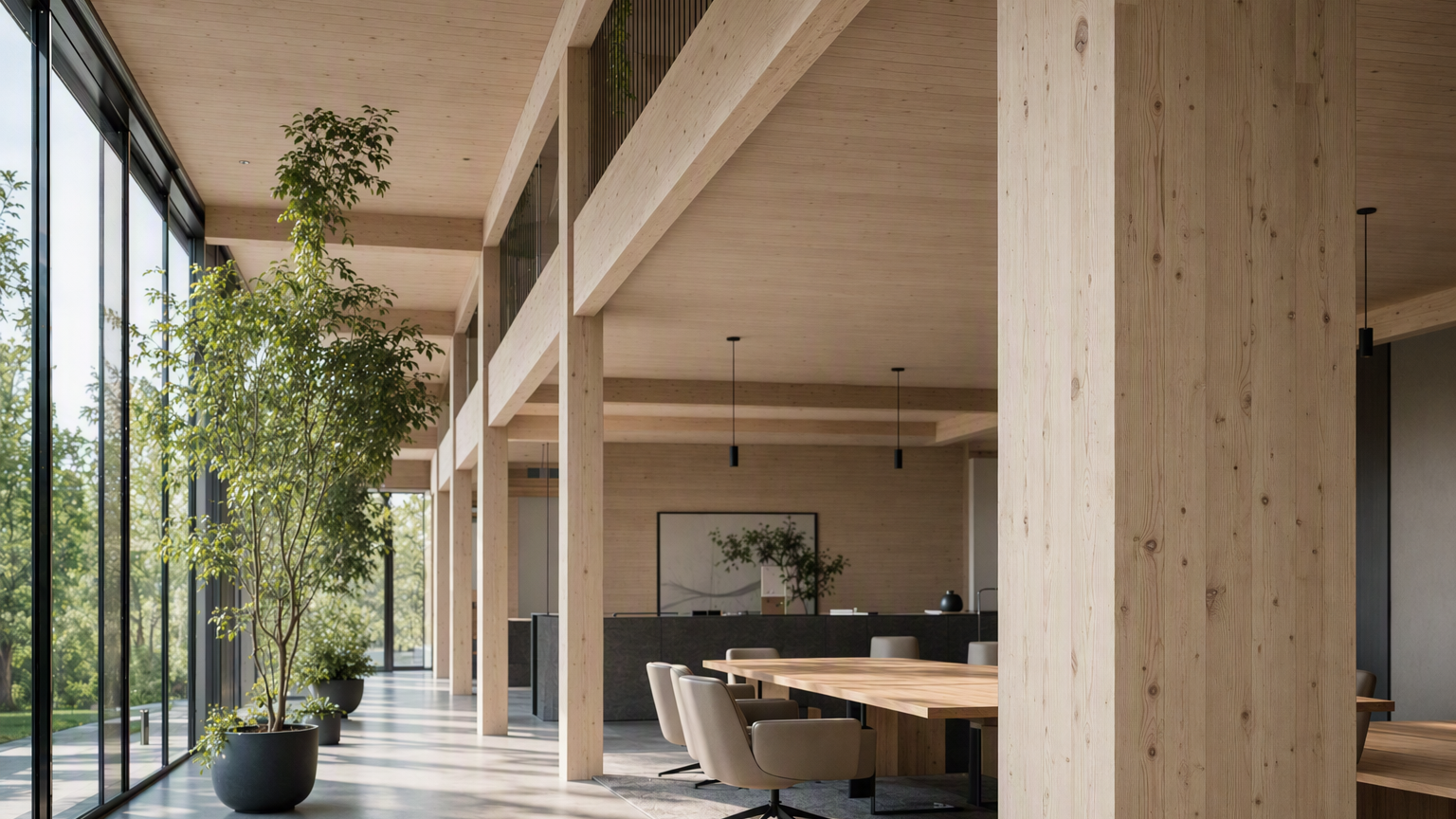
Intumescent fire protection systems for timber construction are becoming increasingly important as the use of wood in modern buildings continues to grow. Driven by decarbonization goals and sustainable design strategies, timber is now widely used in residential, commercial, and public construction projects.
However, this development also brings a major technical challenge: fire safety management. Although wood has a well-known and relatively predictable fire behavior, it remains a combustible material whose performance must be considered from the very early stages of a construction project.
In this context, intumescent systems play a key role in passive fire protection. They help improve the fire reaction performance of wooden elements while preserving their aesthetic qualities, which has become a decisive factor in many contemporary architectural projects.
Contrary to common misconceptions, wood does not instantly burn when exposed to fire. Under the effect of heat, it undergoes a thermal decomposition process known as pyrolysis. This transformation progressively creates a charred layer on the surface.
This char layer provides temporary protection by limiting heat transfer to the inner layers of the material. This is one of the reasons why the fire behavior of wood is often considered more predictable than that of certain other construction materials.
However, this natural protection has its limits. The charring rate depends on several factors, including the wood species, material density, geometry, moisture content, and fire exposure conditions. In projects where wood remains visible, additional protective measures are often required to meet applicable fire safety regulations.
Fire protection in timber construction relies on two complementary concepts that are often confused.
Reaction to fire refers to the contribution of a material to the development and spread of a fire. It evaluates parameters such as ignitability, heat release, smoke production, and the possible formation of flaming droplets.
Fire resistance, on the other hand, refers to the ability of a building element to maintain its mechanical strength, integrity, or insulation performance for a specified period during a fire.
Intumescent paints and coatings mainly contribute to improving the reaction to fire performance of wooden surfaces. They therefore make it possible to integrate more visible wood into buildings while complying with applicable regulatory requirements.
An intumescent system is a technical coating designed to react when exposed to high temperatures.
When subjected to fire, the intumescent film undergoes a series of physicochemical reactions that lead to the formation of an expanded carbonaceous foam. This multicellular layer acts as a thermal barrier by reducing heat transfer to the substrate.
By slowing down the heating of the material, it helps delay its degradation and limits fire spread. This mechanism extends the time available for occupant evacuation and emergency response.
However, the effectiveness of an intumescent system depends on numerous parameters, including its formulation, the applied thickness, the nature of the substrate, and compliance with the application conditions validated during regulatory testing.
In timber construction projects, reaction to fire requirements are often a key consideration from the design stage onward. Depending on the building type and the applicable regulatory framework, exposed timber elements may need to achieve specific performance levels assessed according to the European standard EN 13501-1 and the testing methodologies used by the CSTB.
To meet these requirements, intumescent systems are frequently used to improve the fire behavior of surfaces while preserving the natural appearance of the material. The performance achieved is always linked to a complete system validated through standardized testing, including the substrate, the coating, and the application conditions defined in the test report.
The development of timber construction has led to numerous technical recommendations regarding fire safety, published by professional organizations and public authorities. Technical guides dedicated to fire spread in timber façades are also available online.
To address these requirements, intumescent systems are widely used to improve the fire performance of surfaces while maintaining the aesthetic appearance of wood. The resulting performance is always associated with a complete system validated through standardized testing, including the substrate, the coating, and the application conditions defined in the official test report.
The performance achieved during reaction to fire testing can only be guaranteed when the entire system is applied in accordance with the technical specifications.
Surface preparation, ambient conditions during application, applied film thicknesses, drying times, and compatibility between the different coating layers all play a decisive role in the final result.
In some cases, the addition of a specific topcoat can also improve moisture resistance, facilitate surface maintenance, or enhance system durability without compromising fire performance.
For both specifiers and applicators, compliance with test reports and technical recommendations is therefore essential to the success of the project.
In contemporary timber construction, improving the reaction to fire performance of exposed wooden surfaces has become a key design challenge. Achieving the expected performance levels relies on systems validated through testing and on strict compliance with application requirements.
Intumescent solutions therefore make it possible to integrate wood into projects with demanding regulatory requirements without compromising architectural intent. Vernijura’s F’Lineo range follows this approach by offering protection systems tailored to the technical and aesthetic challenges of modern timber construction.


